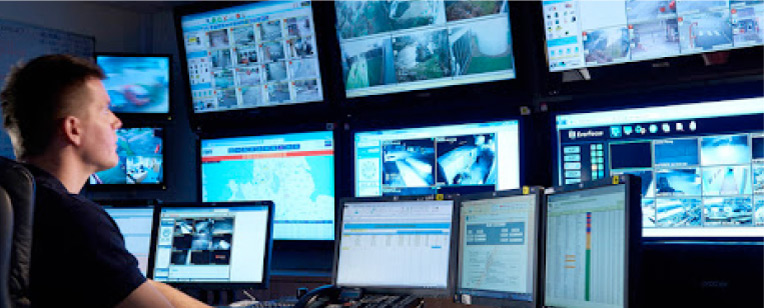
An Alarm Receiving Centre (ARC) can be a major part of a company’s system set-up, especially in relation to their security and fire safety alarm systems. In this article we’ll answer the questions of what is an alarm receive centre and what services do they offer?

What is an Alarm Receiving Centre?
An Alarm Receiving Centre, otherwise known as an ARC, is a purpose-built facility that monitors multiple companies’ and buildings’ systems for triggers. The most common being security, intruder and fire alarms. This dedicated, secure environment operates 24 hours a day, 365 days a year, ensuring constant vigilance over your critical assets.
Within an ARC works teams of monitoring operatives, who are highly trained to react quickly when an alarm is triggered. The team will constantly monitor the centre for any incoming alarms and will take appropriate action if they do occur, such as calling for a police response. Evaluating Alarm Receiving Centres based on their training protocols and response times is crucial for businesses selecting a provider.
An Alarm Receiving Centre, therefore, becomes fully responsible for dealing with a company’s alarm system when there is a fire or breach of security. It takes the responsibility and pressure off of the company’s employees and adds an extra layer of security to their system, due to 24hr monitoring. Given that police-recorded robbery of business property increased by a significant percentage in the last year, the presence of reliable, round-the-clock security monitoring is more critical than ever for UK businesses.
The Evolving Role and Technology of ARCs
In today’s digital landscape, the function of an ARC extends far beyond simple alarm receipt. Modern ARCs integrate cutting-edge technologies like Artificial Intelligence in remote security monitoring and advanced video analytics to enhance accuracy and speed. This focus on technology helps tackle the rising complexity of security threats, including sophisticated attempts at theft, which can have a significant financial impact—for instance, the average claim settled for stolen tools in the UK was over £3,200. A quality ARC must employ redundant systems and backup protocols to ensure uninterrupted service, a topic we cover in depth in how backup protocols are key for remote monitoring.
Furthermore, best-in-class ARCs adhere to the highest industry benchmarks, such as NSI Gold approval. This stringent certification is vital as it not only confirms the ARC’s compliance with all relevant British and European Standards but also often dictates whether a business can secure favourable terms from its insurance provider. Understanding how remote monitoring impacts your insurance premiums can demonstrate the tangible value of selecting a fully compliant monitoring centre.
What Do Alarm Receiving Centres (ARCs) Do?
ARCs act to increase protection against intruders, vandalism, damage and fire by providing a rapid alarm identification and actioning process. Here is what happens when an alarm is triggered…
- An alarm is triggered at a client’s site.
- A signal is sent from the client’s system control panel to the ARC.
- If the signal is received by the ARC and a monitoring operative will immediately look into the case.
- If it is within the site’s working hours, an operative will contact the site and confirm the alarm to be legitimate and not false. False alarms do happen and by checking with the site first, we are able to prevent waste in emergency service resources, as well as business downtime for the site.
- If the alarm is out of working hours then the operative will confirm whether it be a false alarm themselves by checking CCTV and audio footage if possible. If this is not plausible, they will skip to the next step.
If the alarm is a legitimate alarm or it is out of the site’s working hours, the monitoring operative will take the most appropriate action within a matter of minutes. This could be in the form of an audio challenge to an intruder, contacting the police or fire brigade as well as notifying the keyholder. For businesses operating in sectors like manufacturing and waste recycling, where site security is complex and remote, a fast, verified response is non-negotiable.
The ARC, therefore, acts to provide a fast and reliable response to any alarm systems that give businesses peace of mind that their sites are being watched over for any suspicious activity 24/7, for 365 days of the year. The increasing sophistication of video verification technology and the integration of machine learning—which dramatically reduces false alarms—are key trends in CCTV monitoring trends in 2025.

Expanding the Horizon: Beyond Security
While security remains the core function, many modern ARCs, like RMS, now offer an extensive range of non-security monitoring and critical infrastructure services. This holistic approach is essential for facility managers looking to centralise their entire monitoring strategy. For example, remote monitoring for environmental factors can safeguard against costly downtime and damage. The ability to monitor elements such as temperature, humidity, and water ingress is vital for sectors like restaurants and facilities housing sensitive equipment. We detail the advantages of combining fire, security, and environmental monitoring systems to achieve maximum operational efficiency and site safety.
This capability to monitor multiple systems from a single, secure location ensures a proactive approach to all potential risks, providing a cohesive layer of protection for every aspect of a business’s operation, from traditional intruder monitoring to the maintenance of specialist non-security equipment.
What Services do ARCs Offer?
Alarm Receiving Centres can monitor a large variety of systems, including:
- Fire Alarm Monitoring – Professional monitoring of your entire fire alarm system, ensuring prompt compliance and response.
- Intruder Alarm Monitoring – Full monitoring of all your intruder alarms across all sites, providing police-level response where required.
- CCTV Monitoring – Monitoring of all CCTV cameras, often incorporating video analytics to verify alarms before escalating.
- Lone Worker Monitoring – Constant monitoring of lone workers to provide an extra layer of protection to those that work alone, a key part of remote health and safety patrols.
- Fridge Freezer Monitoring – Critical for temperature-sensitive industries like healthcare and food services to prevent stock loss.
Some ARCs are also able to monitor and remotely control other business systems, to further increase your site security and save you costs in the long run.
- Remote Site Access – Eliminates the need for on-site security by remotely protecting a site from unwanted visitors and managing access for staff and contractors.
- Remote Arm/Disarm – No need for multiple employees to hold security information and have the responsibility to arm and disarm the security systems at the end and beginning of the day, a vital service for office and co-working spaces.
- EV Charge Point Monitoring – Monitoring the security and functionality of electric vehicle charging infrastructure, a growing necessity across many sectors.
ARCs can therefore play a very important role in the safety and security of business premises and their employees. By offering both traditional and non-security services, they provide a centralised point of control for total facility safety and management.
At RMS, we are NSI Gold approved, demonstrating our commitment to maintaining the highest industry standards, and go above and beyond to provide world-class service to our clients. From our 5* hand-picked operators to our embracing of new and innovative new technologies, we are dedicated to providing fast and effective response. We invite you to learn more who we are and how our rigorous standards benefit your business.
Whether you’re looking for a new monitoring contract, changing from an existing monitoring provider or looking for call handling services, get in touch online or call 0330 002 1149 for a no-obligation, free quotation.
Share: